
Long before it was a surname associated with boats, auctions, and the New Bedford fishing community, canastra was a Portuguese word for a sturdy basket used to carry food, often fish.
But while the Canastra family’s roots in the Azores were shaped by maritime trade, their connection to the fishing industry would actually emerge some time later.
The Canastra name would come to align with the role the family would play in New Bedford’s modern fishing economy—and their responsibility to the community built around it.
Finding the waterfront
The Canastra family’s voyage into seafood began with Raymond Canastra. Born in New Bedford and raised in nearby Fairhaven, he grew up close to the harbor and would watch the comings and goings of the fishing community around him with interest.
In the late 1970s, Raymond joined the lumpers on the New Bedford docks. Draggers routinely returned with loads exceeding 120,000 lbs of codfish, requiring multiple crews to unload vessels through the night.
Watching friends transition from the docks to the vessels, and seeing the livelihoods they were able to build, Raymond decided to go to sea himself. Over time, he earned himself a place aboard a boat and eventually became a captain.
While Raymond built his understanding of the industry on the water, his brother Richard took a different route. After graduating from Fairhaven High School, Richard entered the snack food business, operating wholesale routes across Rhode Island and Massachusetts. By his mid-twenties, he had built and managed a regional operation, gaining firsthand experience in sales, logistics, pricing, and cash flow.
After years at sea, Raymond wanted a role that would allow him to stay closer to home and raise his young daughter, Cassie. It was a decision that naturally pulled him toward family.
Two paths converge
In 1989, the brothers decided to work together. They launched a shoreside unloading and wholesale operation, initially handling scallopers before expanding into draggers.
Raymond told NOAA at the time, “I talk all the boat talk with the boats. Richard takes care of all the business end of it.
“The boats are getting paid. The money’s being collected. I can do my gig and he does his. It works out well.”
Richard added, “We complement each other. It’s only been positive for us because we’re just not looking one way, we’re looking at all the aspects of the business.”
Together, the Canastra brothers built a business that worked for them and the boats they served. But beyond their own operation, the broader system on the waterfront was beginning to show deep cracks.
A fair auction for New Bedford
The private auction that followed the fishermen’s strike of the mid-1980s operated behind closed doors, relying on informal arrangements that left little room for transparency. Pricing disputes and inconsistent weights became routine. For vessels coming off long trips, the fight often continued long after they tied up.
Looking for alternatives, Raymond and Richard traveled to Portland, Maine, where the city operated a publicly owned display auction. There, fish was laid out for inspection before bidding began. Buyers competed openly on what they could see, and fishermen understood how prices were reached.
The model resonated with the Canastra brothers. In 1994, they brought that concept to New Bedford with the Whaling City Seafood Display Auction. The operation was modest at first, and the first days were uncertain, but buyers soon realized its potential.
The display auction worked.
A new horizon

In the mid-1990s, Richard traveled to Brussels for an international seafood trade show, originally looking for buyers for skate wings. While there, he was introduced to an electronic auction system used across Iceland. Entire national markets operated through digital bidding, allowing buyers to participate remotely while maintaining real-time price discovery.
Richard spent weeks in Iceland studying how the system worked, then returned to New Bedford to adapt it for the U.S. market. The brothers installed dedicated communication lines, built the necessary infrastructure, and worked closely with vessels and buyers to prepare them for a fundamental shift in how seafood would be sold.
In February 1997, they launched the Buyers and Sellers Exchange (BASE).
Sellers and buyers no longer occupied the same room during bidding. The separation protected the process from influence and allowed prices to reflect quality alone.
By changing how transactions happened, the Canastra brothers changed what fairness looked like on the waterfront.
Pressure on the system
The launch of the electronic auction marked a turning point for the New Bedford waterfront, but it also brought resistance.
Tensions surfaced in the form of threatening phone calls. Then, late one night, Raymond was called to an alarm at the auction building. He discovered gasoline fumes and a five-gallon drum beneath the auction floor with an unlit wick attached. Fire officials later confirmed that, had the device been lit, the damage would have been extensive.
Raymond and Richard restored the facility, brought the auction back online, and continued operations. By the end of that year, BASE had become the only electronic seafood auction operating in the United States.
Raymond said, “We were the first company in New Bedford to have digital scales that are checked monthly just for their accuracy.”
That approach to market transparency and regulation was later examined in broader discussions of the U.S. seafood industry, including Richard being featured on Netflix’s Rotten series.
Despite the pressure, the system held. And as it did, its influence on the waterfront expanded quickly.
Reshaping the waterfront
By the early 2000s, the auction handled product from roughly 180 vessels and more than 40 buyers.
Trucks arrived daily from major seafood markets, including Boston, New York, Philadelphia, Seattle, and ports throughout New England. Scallops alone moved through the system in volumes that helped establish New Bedford as the most valuable fishing port in the United States by dollar value.
Other ports took notice. Operators from across the country reached out to understand how the system worked, asking about digital bidding, vessel coordination, and communication infrastructure. The software developed in New Bedford was soon licensed for use in ports across the country and in Canada.
What began as a response to local challenges had become a model for modern seafood marketplaces.
As the auction’s influence grew, Richard’s role on the waterfront expanded beyond operations. He served for 10 years as a commissioner on the New Bedford Harbor Commission, represented the city on the New England Fishery Management Council, and spent eight years on the groundfish committee.
The next generation

Cassie Canastra grew up alongside the operation, watching her father manage the demands of the waterfront while her mother handled administrative work from home.
The work fascinated her. Every day, Raymond walked her to Saint Joseph School in Fairhaven, fielding a steady stream of fishing industry questions along the way.
Cassie’s parents encouraged her to pursue opportunities outside of the pressures of the fishing world. For a time, Cassie built a career away from the docks, working as a teacher.
But Cassie soon returned to the family business in an undefined role, initially helping with social media. As the auction continued to modernize, her role expanded. She became Director of Marketing and oversaw the implementation of new software that allowed buyers access to the auction through tablets and smartphones.
Cassie pursued formal training alongside her work, completing a master’s degree in fisheries science at UMass Dartmouth’s School of Marine Science and Technology, with a focus on groundfish. She also managed a New Bedford groundfish sector, where she helped overturn NOAA’s groundfishing ban.
Cassie had developed a working understanding of every part of the operation, from auction mechanics to policy discussions. When Raymond and Richard decided to step back from daily management, Cassie was ready to take the helm.
Carrying the name forward
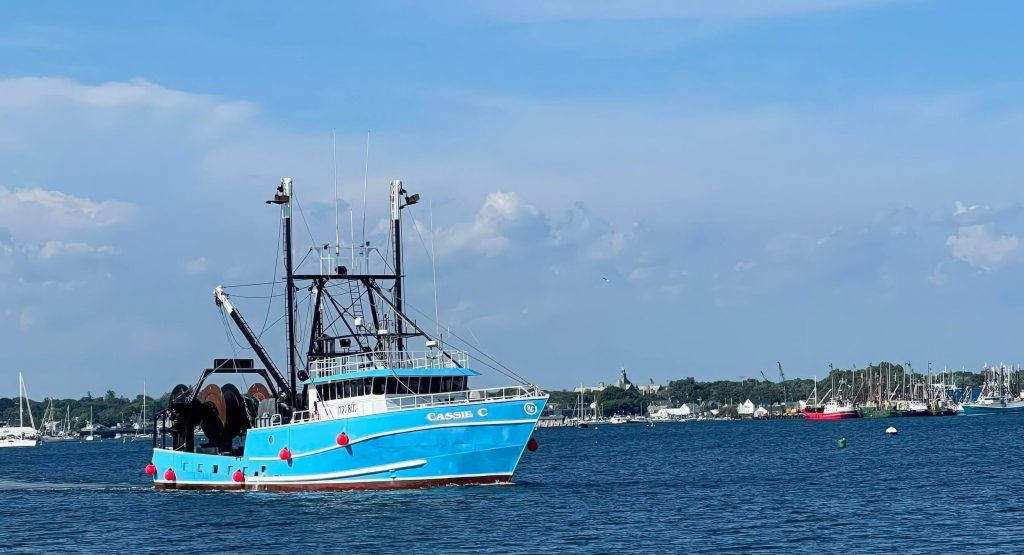
As Cassie stepped into leadership, the broader fishing industry faced a period of instability. Market pressures, regulatory shifts, and changes in ownership structures across the waterfront introduced uncertainty for vessels, crews, and shoreside operations alike.
Cassie approached the situation with clear priorities: protecting jobs, preserving access, and keeping working infrastructure in place. It’s a philosophy and work ethic that would see her be awarded SouthCoast Woman of the Year in 2018.
As New Bedford Port Authority Executive Director Ed Washburn put it, “Having somebody like her that’s credible, that’s smart, and that truly cares is really invaluable when it comes to advocating for whatever issue, and there’s plenty.”
Canastra Fishing Company emerged as a natural extension of those values. It formalized the family’s direct involvement on the water, connecting the catch and marketplace.
Built by fishermen and shaped by decades of firsthand experience, the company reflects a practical understanding of what dependable supply requires. The fleet operates with respect for the resource, accountability to crews, and a commitment to delivering consistent, traceable product into the market.
As CEO, Cassie continues to guide that work with the same long-term perspective that defined every stage of the family’s history.
“It’s all I know,” she told the New Bedford Light. “It’s a family business, but it’s more than that. It’s about keeping the industry and this community alive. That’s what matters most to us.”
What began as a surname rooted in the Azores evolved into a deep connection with New Bedford’s working waterfront. The Canastra name now stands for systems that carry fairness, and a family that understands the weight of responsibility that comes with shaping a marketplace the community depends on.
Canastra Fishing Company connects buyers with fresh, traceable, domestic-caught seafood from the nation’s most productive fishing port. Drop us a line to source directly from the waterfront and be part of this community’s story.
About The Author