
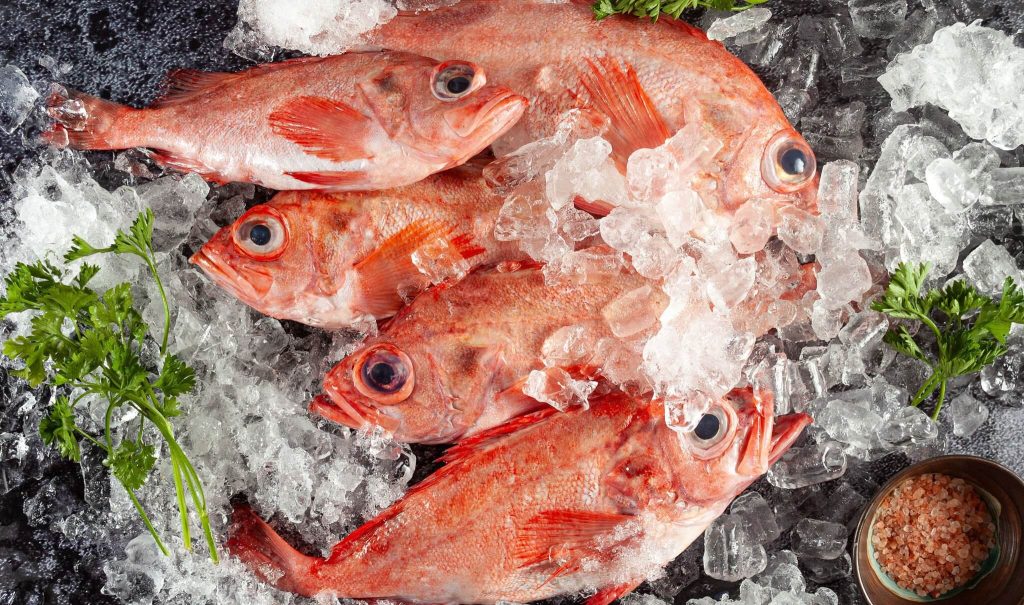
Few whitefish arrive at the dock looking quite the way redfish does.
Its red-orange skin stands out immediately against the ice. Beneath the vibrant color lies clean, pale flesh with a firm but flaky structure; familiar, yet distinct enough to make you pause and look twice.
Acadian redfish is a unique species that has been part of New England fishing for generations, though not always in equal measure. Periods of heavy pressure reshaped the fishery, forcing long stretches of restraint and recovery.
But redfish has returned under regulations that support long-term stability and sustainability. And that steadiness matters to today’s buyer.
Redfish: An overview
Acadian redfish (Sebastes fasciatus), also known in wholesale channels as “Atlantic ocean perch” or “golden redfish,” is a cold-water whitefish harvested from the Gulf of Maine and Georges Bank.
Redfish belongs to the rockfish family, not snapper or drum. Rockfish grow slowly, live long lives, and require tightly managed fishing strategies. They are ovoviviparous, a reproductive process in which eggs develop internally before the young are released.
Unlike many global whitefish species that depend on extended processing routes and multi-country handoffs, redfish moves through shorter, more transparent domestic systems for U.S. buyers.
In practical terms, redfish behaves more like a planning species than a reactionary one. It doesn’t spike dramatically in volume or disappear without warning. It shows up week after week, which is exactly what large-scale procurement teams value.
That reliability explains why redfish increasingly appears alongside pollock and haddock in today’s sourcing conversations—complementing them rather than competing with them. Each species plays a different role, and redfish fills the space between volume security and differentiation.
MORE: The domestic wild-caught whitefish species buyers need to watch in 2026
A brief history of redfish

For much of the mid-twentieth century, Acadian redfish formed the backbone of New England’s frozen whitefish trade. Its mild flavor, steady landings, and suitability for filleting made it a natural fit for large-scale processing.
That approach eventually caught up with the industry. By the 1980s, decades of heavy pressure had reduced stocks and forced a fundamental reset. Quotas tightened, access narrowed, and management shifted from maximizing landings to rebuilding long-term stability.
Over time, coordinated federal management and controlled harvesting allowed the stock to rebuild. By the early 2010s, regulators formally recognized Atlantic ocean perch as rebuilt.
But unlike species that rebound quickly and then swing wildly with demand, redfish came back under limits designed for long-term stability. That history is why today’s landings look steady instead of explosive, and why buyers see consistency rather than spikes.
How redfish is caught

Acadian redfish is caught from the cold, rocky bottoms of the ocean using regulated bottom trawl gear. Quotas, seasonal oversight, and monitored landings shape how much the fish comes to market and when.
Redfish are graded quickly, iced promptly, and moved efficiently through domestic channels. Fewer handoffs mean fewer freeze cycles, less moisture loss, and more uniform yield downstream.
In practical terms, buyers receive fish that behaves the same way week after week. Color holds. Texture stays intact. Portioning remains predictable. Today, those handling advantages matter more than ever.
What does redfish taste like?

Redfish delivers a mild, slightly sweet flavor with a clean finish and a medium flake. It doesn’t lean oily, briny, or assertive. It lands squarely in familiar whitefish territory, close to cod and haddock.
From a buyer perspective, redfish doesn’t force menu rewrites or consumer education campaigns. As buyers look to expand or rebalance whitefish portfolios, species that require justification slow everything down. Redfish moves in the opposite direction. It feels known even when it’s new to a menu, which allows teams to introduce it without disrupting flow.
How to cook redfish

Redfish behaves the way experienced kitchens expect whitefish to behave. It holds together under heat, releases moisture predictably, and responds well to standard preparation methods already in use across retail and foodservice.
Pan-searing remains the most common approach, especially for skin-on fillets. The skin crisps cleanly while the flesh stays tender, producing a familiar presentation that doesn’t require adjustment in timing or technique. Baking and roasting work just as well for batch preparation, where consistency matters more than flair.
Redfish also performs reliably in stews, tacos, and wraps, where flake integrity and moisture retention carry more weight than appearance. It absorbs seasoning evenly and maintains structure through service, which makes it suitable for high-volume environments.
How to fillet a redfish (and why most buyers never need to)

In wholesale programs, redfish almost always arrives as a finished product.
Buyers typically receive trimmed redfish fillets—fresh or frozen, skin-on or skinless—with frozen formats supporting greater consistency from storage through service. This keeps prep predictable and reduces variability across locations, shifts, and service formats.
In practice, the filleting process mirrors that of other whitefish. The bone structure is straightforward, the fillet releases cleanly, and portioning stays consistent once specifications are set.
More importantly, redfish offers natural consistency in size and texture. Fillets grade evenly, cook uniformly, and perform the same way across batches. For buyers managing large programs, repeatability matters more than marginal differences in price.
At scale, success comes from minimizing surprises. Redfish supports that goal by behaving the same way from delivery through service.
Redfish vs red snapper
Few species comparisons create more confusion than redfish vs red snapper.
Despite similar names and colors, the two fish occupy very different roles in the market. Red snapper comes from warm-water reef systems, carries firmer texture, and often commands premium pricing tied to limited access and demand.
Acadian redfish follows a different path. It comes from cold North Atlantic waters, supports consistent commercial landings, and delivers a mild, flaky profile designed for everyday use rather than special-occasion positioning. Where snapper often anchors center-of-plate features, redfish integrates easily into regular rotation without forcing pricing or menu constraints.
| Attribute | Acadian redfish | Red snapper |
| Primary market role | Everyday whitefish for stable programs | Premium feature fish |
| Habitat | Cold North Atlantic waters | Warm-water reefs |
| Harvest scale | Consistent commercial landings | More limited access |
| Texture | Medium flake, tender | Firm, dense |
| Flavor profile | Mild, slightly sweet | Richer, more pronounced |
| Typical pricing | Moderate and stable | Higher and more volatile |
| Menu placement | Tacos, baked dishes, stews, pan-seared | Center-of-plate features |
| Buyer risk profile | Low operational risk | Higher pricing and availability risk |
Redfish doesn’t replace snapper. It fills a different role, one focused on stability, consistency, and flexibility.
RELATED: Why domestic seafood creates a more reliable supply chain
Supporting domestic fishing communities

Ports like New Bedford rely on species that land consistently, move efficiently, and support crews even when other fisheries slow down.
Redfish does exactly that. Because it lands steadily, redfish helps keep boats fishing, processors running, and logistics moving when more cyclical species rotate out. That stability matters to working crews, but it also matters to buyers who depend on continuity rather than one-off availability.
For sourcing teams, supporting fishing communities doesn’t require abstract claims. It shows up through repeatable contracts, predictable volume, and long-term relationships with fleets that operate under clear rules.
RELATED: Why fair commercial fishing wages matter for U.S. seafood supply
Buyer takeaways

For buyers, Acadian redfish offers steady domestic availability without the volatility tied to long-distance supply chains. It performs consistently across retail and foodservice, and reduces operational friction.
“Buyers aren’t looking for the next trend fish right now,” says David Lancaster, VP of Sales and Business Development at Canastra Fishing Co. “They’re looking for species that show up the same way every week while adding a little variety. Redfish does exactly that.”
In a market where control matters more than novelty, redfish earns its place by staying dependable.
MORE: Whitefish wholesale: Why ‘domestic vs imported’ no longer tells the full story
As buyers rethink stability in a tightening whitefish market, domestic Acadian redfish continues to earn the attention it’s getting. If you’re assessing how redfish fits into your whitefish mix, we’re always happy to talk you through supply, formats, and availability.
About The Author